Management Decisions That Matter (Part I)
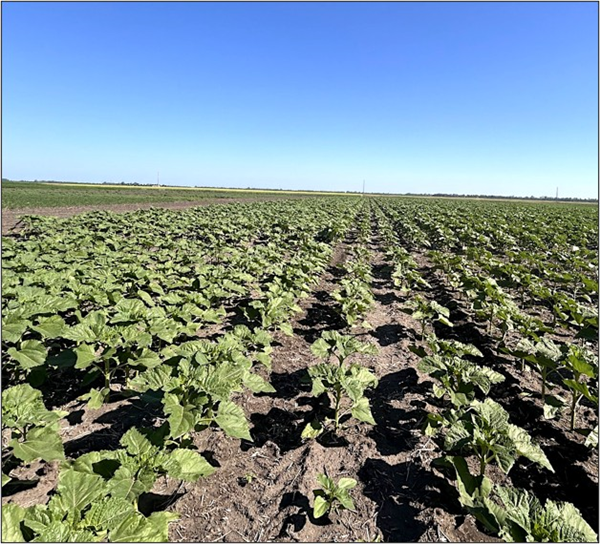 Editor’s Note: Sunflower has a reputation for being a resilient crop, but high yield still depends on getting several management decisions right. The largest opportunities are not necessarily tied to adding more inputs. In many cases, yield is protected by choosing the right field and hybrid, establishing a uniform stand, matching plant population to available water, avoiding unnecessary planting delays, and preventing losses from weeds, insects, and disease.
This article is the first in a series identifying key practices that increase and protect the yield potential already established. The series author, Ana Carcedo, is broadleaf agronomist with North Dakota State University.
We believe this series to be of interest and use to veteran sunflower producers as well as newer ones. Even the longtime grower can benefit from exposure to new information as well as a good set of reminders.
On another point, while planting date recommendations and some other data in this article are geared toward Northern Great Plains producers, High Plains sunflower growers can glean benefits here as well. Contact your own state agronomist regarding recommendations for your growing district.
Rotation Protects Yield Potential
Crop rotation may be one of the easiest management practices to underestimate. Research found sunflower yield was 5% higher following potato, 20% higher following sugarbeet, 8% higher following pinto bean, and 17% higher following wheat compared with continuous sunflower.
The benefits extend beyond yield. Continuous or short sunflower rotations can increase disease, insects, difficult weeds, volunteer sunflower and soil-moisture depletion. Sclerotinia is particularly important when sunflower is grown too frequently. A minimum interval of three to four years between sunflower and other Sclerotinia-susceptible crops, including canola, dry bean and soybean, is recommended.
Rotation also expands weed-management options and can reduce populations of insects that overwinter in sunflower residue.
Management decision: When field options are available, avoid sunflower following sunflower and consider the entire rotation; not simply the previous crop. A field with good stored moisture and a longer interval since sunflower or other Sclerotinia hosts provides a better starting point for protecting yield potential.
Hybrid Selection
Yield is important, but don’t select on yield alone.
Hybrid is one of the most important decisions a sunflower producer makes. Yield trial data should be used to identify hybrids that consistently perform well in one’s production region, but maturity, drydown, standability, oil percentage, herbicide tolerance and pest and disease resistance also need to enter the decision.
Maturity becomes particularly important when planting is delayed. Frost before physiological maturity can reduce yield, oil content and test weight. Earlier hybrids also tend to be drier at harvest, reducing drying costs and potentially allowing harvest before significant blackbird feeding. Planting hybrids of more than one maturity can spread both weather risk and harvest workload.
Standability also has a direct practical value. Hybrids with strong roots and healthy stalks are less susceptible to lodging, stem diseases and damage from insects such as Dectes stem borer.
Management decision: Start with locally adapted, consistently high-yielding hybrids; but among similarly yielding hybrids, use maturity, disease resistance, drydown and standability to reduce the probability of losing that yield before harvest.
Planting Date
There is a wide window, but late planting still has a cost.
Sunflower can be planted from approximately May 1 through late June in the Northern Great Plains, but earlier planting generally provides greater yield potential. NDSU research at Carrington quantified the yield penalty associated with delayed planting. Relative to a May 20 planting date (100% relative yield), yield declined to approximately 96% with May 30 planting, 81% with June 10 planting and 75% with June 20 planting.
Earlier planting can also advance maturity, potentially reducing bird damage and late-season Sclerotinia head rot, although it may increase exposure to certain early season pests. However, planting too early, before soil temperatures reach approximately 50°F, can result in poor germination, slow emergence, and provide greater risk of seedling injury under cold or wet conditions.
As planting is delayed into late June in the Northern Great Plains, the risk extends beyond yield loss. Late planting often reduces oil content and increases the likelihood that mechanical drying will be required at harvest. Therefore, early maturing hybrids should be considered when planting is substantially delayed or when replanting is necessary.
Planting date can also influence seed quality. In a three-year study in southwestern North Dakota, oleic acid concentration was greatest with planting around May 23 and lowest when planting occurred after June 10.
Management decision: Do not treat late May and late June planting as agronomically equivalent simply because sunflower can establish at both dates. As planting moves into June, maturity becomes increasingly important, and the probability of sacrificing yield, oil content and harvestability increases.
Plant Population
 More plants do not necessarily mean more yield.
Sunflower has considerable ability to compensate for plant population. When populations decrease, individual plants respond by producing larger heads and larger seeds.
For oilseed sunflower, the recommended final population is 18,000 to 24,000 plants per acre. For nonoilseed sunflower, the range is 14,000 to 20,000 plants per acre. These are not fixed targets for every field. Lower populations are recommended where water-holding capacity is low, or rainfall is inconsistent, while solid-seeded sunflower should generally be toward the upper end of the range.
An important tradeoff exists at the upper end. Higher populations result in smaller heads, which can speed preharvest drydown; but excessive populations also increase the potential for lodging and stalk breakage.
Row width itself is less important than expected. Seed yield is similar between row-planted and solid-seeded sunflower with rows narrower than 20 inches, when other recommended management practices are followed. What matters more is achieving uniform spacing so that plants can efficiently use water, nutrients and sunlight.
For example, at a target of 20,000 plants per acre, assuming 90% germination and 10% stand loss, seed spacing is about 8.5 inches in 30-inch rows, 9.1 inches in 28-inch rows, and 14.1 inches in 18-inch rows.
Management decision: Target population by sunflower type and water availability rather than automatically increasing seeding rate in pursuit of yield. For oilseed sunflower, 18,000 to 24,000 plants per acre is the useful decision range; move toward the lower end under limited water and toward the upper end under higher-yield environments or solid seeding.
Uniformity / Population
At planting, the goal should not simply be to reach a target plant population, but to establish that population as uniformly as possible. Avoiding doubles and adjusting the planter to match seed size are important for achieving consistent seed spacing and emergence. Grain drills and air seeders can also be used successfully, but uniform planting depth and spacing may be more difficult to achieve without proper equipment adjustment.
Sunflower presents an additional challenge because its seed is relatively light. Unlike heavier crop seeds that help keep planting units stable, sunflower seed adds little weight to the planter. At higher travel speeds, planter units may bounce, resulting in variable seed placement and planting depth. Poor seed placement can increase seedling mortality and contribute to uneven stands. NDSU research on sunflower seed placement found that improved planting technology and more-uniform establishment could increase profitability by approximately $90 per acre.
Management decision: Before increasing seeding rate, make sure the planter can deliver the desired population uniformly. Calibration, seed size, doubles, skips and seed placement may matter more than adding another 1,000 or 2,000 seeds per acre.