By Sam Markell, Bob Harveson & Febina Mathew*
Have you ever had trouble identifying stem diseases? Or remembering which diseases are economically important? If so, thinking about Black, Grizzly and Polar bears can help!
In August and September, three common stem diseases appear: Phoma black stem, Phomopsis stem canker and Sclerotinia mid-stalk rot. The pathogens causing these diseases infect leaves, progress through the petiole, and form an ugly stem lesion centered on leaf axils. That’s where the similarity ends, and our bears help tell the differences.
The Black Bear
(Phoma Black Stem)
As the name implies, Black bears are indeed, black. They are the smallest of the three North American bears and are far more common than Grizzly and Polar. Relatively speaking, Black bears are also far less dangerous. Sure, once in a while their dumpster-diving, campground-stealing habits can be a nuisance, but we would much rather encounter a Black bear than face either of the others.
‘Phoma’ lesions are black and small, typically only one to two inches long. Phoma is, by far, the most common stem disease in North America. Fortunately, it’s the least important, as lesions are superficial and rarely impact yield. If it were to become a problem, fungicides are very effective. It’s much better to have a Phoma encounter (and you likely will) than the other two diseases.
The Grizzly Bear
(Phomopsis Stem Canker)
Grizzly’s are also called ‘brown bears’ for a reason: they are indeed, brown. They are much larger than a Black bear, and we would imagine can do a frightening amount of damage if you are unfortunate enough to encounter one. It’s a good thing they are less common than Black bears!
Phomopsis’ lesions are large (six to eight inches or more) and brown. The disease hollows out the stem beneath the lesion, causing wilting and/or lodging. In years with frequent rains, epidemics can occur and cause a frightening amount of yield loss. Although not nearly as common as Phoma, Phomopsis encounters do occur frequently. When they do, it’s hard to manage; best to stay on top of this one!
The Polar Bear
(Sclerotinia Mid-Stalk Rot)
Polar bears are white or cream colored — and they are enormous. Polar bears might just be the most frightening bear of all. They’re incredible hunters that stalk humans (yikes!). Thankfully, they are less common than Grizzlies and much less common than Black bears.
Sclerotinia mid-stalk rot (also called mid-stem rot) is one of the many ‘white mold’ diseases caused by Sclerotinia sclerotium. Sclerotinia mid-stalk rot lesions are very large. Their color ranges from vanilla, tan to cream, which may lighten as they age, until resembling dried bone when mature. A fluffy white mold (and small black sclerotia) is frequently often observed on/in the lesion. The lesion causes wilting and lodging, and by the end of the season only spindly fibers of the affected stem may remain.
Sclerotinia mid-stalk rot is the least common of the stem diseases and much less common than Sclerotinia head rot (same disease, different plant part). That’s fortunate, as this one is ‘Polar-bear-scary.’ It even has ‘stalk’ in its name!
Open Season! (Scouting)
Now is the best time to hunt for the three common stem diseases. The colors and sizes of the developing lesions are easy (relatively) to distinguish on the green stems. Phomopsis and Sclerotinia will begin compromising lesion integrity, and ‘white mold’ may be visible on lesions caused by the later.
We can’t manage stem diseases this late in the season, but knowing what’s threatening your fields helps you prepare for the future. Crop rotation will help manage all three diseases.
Although we wouldn’t necessarily call any hybrids “resistant,” planting “less susceptible” hybrids is important, particularly if Phomopsis is a threat. A preventative fungicide application may also reduce the threat of Phomopsis, so factoring that in might be prudent.
If you are finding high levels of Sclerotinia mid-stalk rot, prepare to manage white mold on future broadleaf crops in that field. If you are finding Phoma, that’s OK! The dumpster-diving Black bear of stem diseases rarely does any real damage.
Happy Hunting!
For more information on the three stem diseases discussed in this article, as well as several other less-common stem diseases (Panda bears, perhaps?), check out the updated disease section at www.sunflowernsa.com (under ‘growers’ -> diseases tab), or the NDSU Extension publications: ‘Sunflower Disease Diagnostic Series’ (PP1727) or the new ‘Phomopsis Stem Canker of Sunflower’ (PP2300).
* Sam Markell is professor and extension plant pathologist with North Dakota State University. Bob Harveson is professor of plant pathology at the University of Nebraska-Scottsbluff. Febina Mathew is associate professor of plant pathology at North Dakota State University.
The authors thank members of the Sunflower Pathology Working Group for their contributions to this article and acknowledge the NCIPM Center which is supported by the Crop Protection and Pest Management Program, project award no. 2022-70006-38001, from the U.S. Department of Agriculture’s National Institute of Food and Agriculture. We are grateful for the funding support provided by the USDA National Institute of Food and Agriculture-Critical Agricultural Research and Extension (CARE) (Award Number: 2024-69008-42655) for this material. Finally, we thank the National Sunflower Association for its continued support of research, Extension and education efforts to improve disease management.
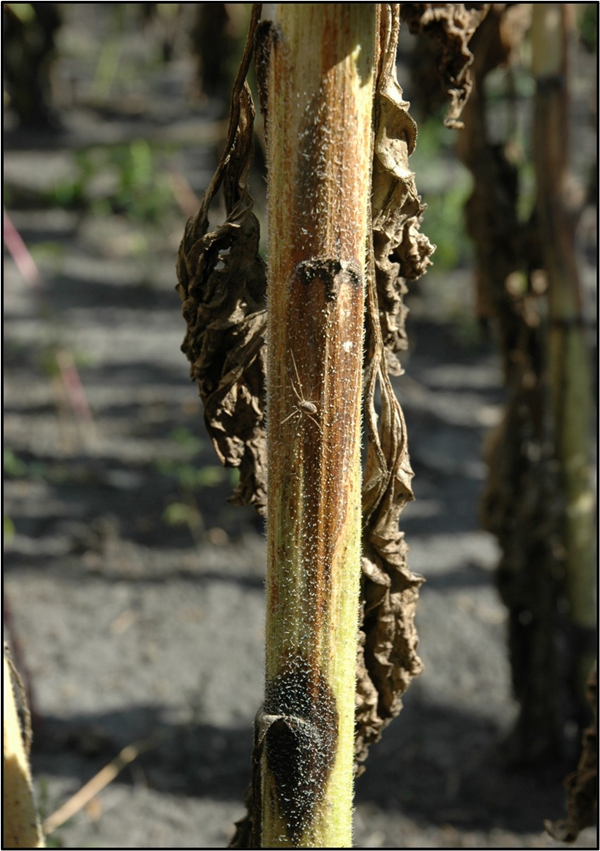 |
This image shows small black lesions indicative of Phoma black stem. Fortunately, the lesions are superficial and rarely impact yield.
|
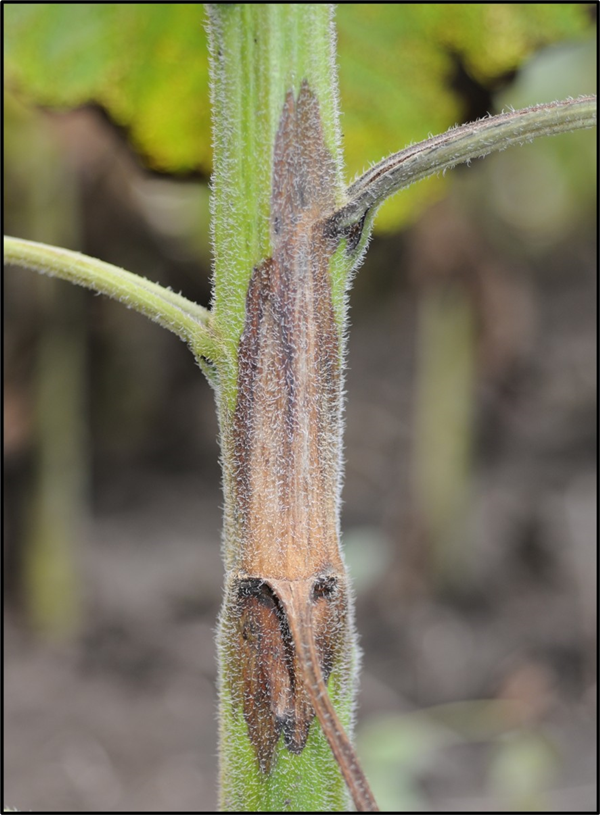 |
The Phomopsis stem canker lesions are quite large and can lead to a hollowing out of the stem beneath. Yield losses can be dramatic due to wilted and lodged sunflower plants in infected fields that have been hit with heavy rains.
|
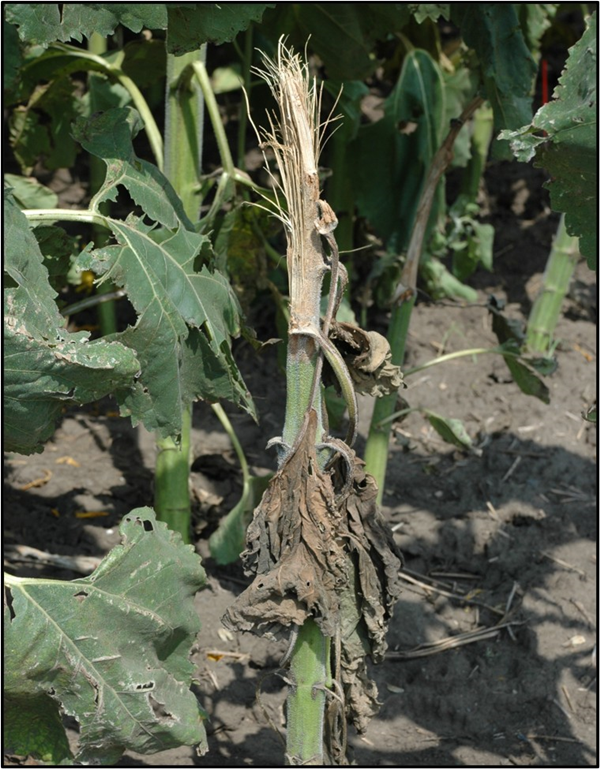 |
Mid-stalk rot is one of the “white mold” diseases caused by the fungus Sclerotinia sclerotium. It’s less common than Sclerotinia head rot, but its large lesions result in stalk damage leading to late-season wilting and lodging.
|