USDA-ARS research entomologist Jarrad Prasifka discussed the insect — and blackbird — findings from the 2025 sunflower crop survey during the 48th NSA Sunflower Research Forum held in Fargo, N.D., in early January.
As noted in a summary carried in the January issue of The Sunflower, the 2025 crop survey encompassed 191 sunflower fields in six states (North Dakota, South Dakota, Minnesota, Nebraska, Kansas and Colorado) and Manitoba. That compared to 220 fields in the most recent biennial survey in 2023 and 164 fields in the 2021 crop survey.
Visual in-field damage from birds was well below that of 2023 in North Dakota, the state with the highest numbers of surveyed fields. Rated bird damage in 104 North Dakota sunflower fields was below 4% in 2025, compared to almost 8% on average across 127 fields in 2023. The South Dakota bird damage was higher in 2025, though, with a 4% average, compared to just over 2% two years earlier. Bird damage was slight to negligible in other areas.
In-field assessments of seed maggot damage showed wildly variable findings, with North Dakota surveyed fields having close to 18% of heads with apparent feeding by seed maggot in 2025 — much higher than in 2023 — while other states stood at small to none. It was a similar story with the sunflower bud moth. Dectes stem borer was significantly more common in Kansas and Colorado, followed by South Dakota — but quite low in North Dakota.
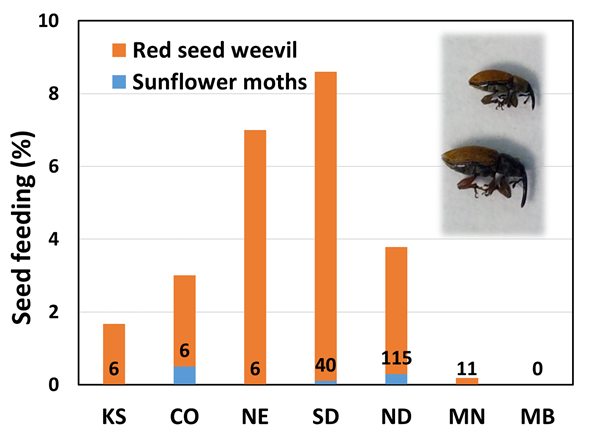
Damage by the red sunflower seed weevil and the sunflower head moth in 2025 was determined via post-harvest evaluation of seed samples. X-ray imaging of the seeds was used to determine damage levels. The evaluation showed an average 8%+ seed damage level due to red seed weevil in South Dakota samples (40 fields), followed by 7% in the six surveyed Nebraska fields. North Dakota’s 115 surveyed fields had less than 4% seed weevil feeding incidence, on average, although the percent-age was higher in surveyed fields in the southwestern corner of the state.
Seed damage due to sunflower moth was very low across all survey areas.
A copy of Prasifka’s Sunflower Research Forum PowerPoint presentation is being posted on the NSA website, www.sunflowernsa.com. Click on “Research” and then “Research Forum Presentations — 2026.”
Below: This schematic illustrates percentage of seed feeding by the red seed weevil and sunflower moth in analyzed samples in the 2025 sunflower crop survey. The numbers at the bottom of the bars represent the number of fields sampled for these two insects in each state.