By Mike Krueger*
The January series of USDA reports were bearish across the board. In fact, they were bearish across all boards.
Increases in production for corn, wheat and soybeans were larger than expected. Demand cuts in some categories more than offset demand increases in other categories. Ending supplies of wheat, corn and soybeans were all increased.
These reports were the “final” 2025 U.S. row-crop production estimates. Markets traded sharply lower following the release of the reports on January 12.
Here’s what the USDA told us:
Corn —
• Planted acres were increased another 1.3 million. 2025 corn planted acres have now been increased by 4.5 million (5%) since the June estimate. That is unprecedented. It accounts for almost a billion-bushel (63 MMTs) increase in corn production in the last six months.
• The national average corn yield was increased by 0.5 bushel per acre. Many analysts were expecting a decrease. This is a new record corn yield.
• The U.S. corn crop will be a new record by a wide margin. Production was increased by 269 million bushels.
• The corn export forecast was left unchanged. I believe this will eventually be increased because of the strong pace of corn export sales.
• Corn ending stocks were increased by 207 million bushels and now stand at more than 2.2 billion bushels.
Soybeans —
• Planted acreage was increased by 100,000 acres. This is not significant, but it is interesting that both corn and soybean acres were larger than expected.
• The soybean yield estimate was left unchanged. Some analysts were expecting a yield decline.
• The export forecast was cut by 60 million bushels (China factor).
• Ending stocks went from 290 million bushels to 350 million bushels. This isn’t necessarily a bearish number, but it went up instead of down.
Wheat —
• There were no changes in the U.S. wheat production numbers.
• The wheat export forecast was left unchanged.
• Wheat feed usage estimate was reduced 20 million bushels (too much corn around, coupled with smaller livestock numbers).
• Wheat ending stocks increased from 901 million bushels to 926 million bushels.
• Winter wheat planted acres were also larger than expected.
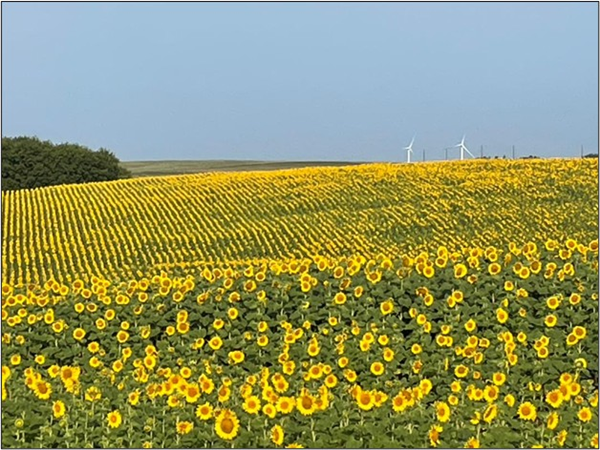
USDA finally released their estimate of the 2025 U.S. sunflower crop. They estimated 2025 sunflower production at 2.32 billion pounds, up 103 percent from 2024. The United States average yield of 1,863 pounds per acre increased 193 pounds from 2024 and set a new record.
Planted area, at 1.29 million acres, was 79% above the previous year. Area harvested increased by 82% from 2024 to 1.25 million acres.
North Dakota, the leading sunflower producing state during 2025, produced 1.09 billion pounds, an increase of 111% from 2024. Production in South Dakota increased 86% from 2024 to 866 million pounds.
United States production of oil-type sunflower increased 126% from 2024, with harvested acres up 104% from 2024. Production of nonoil sunflower varieties was estimated at 189 million pounds, a decrease of 4% from 2024 on fewer planted acres.
It was another great year for sunflower production.
 On the world side of the numbers, the USDA increased Russia and Argentinae wheat production a combined total of five million metric tons (183 million bushels). There are questions about the quality of Argentina’s big crop. World wheat supplies are big, but quality and protein could be a problem later in the marketing year. The USDA increased Brazil’s soybean production estimate to 178 MMTs. This was not a surprise to the market.
Lastly, the quarterly stocks numbers confirmed the record crop production, but also confirmed that demand was also very strong. Corn stocks as of December 1 were up 10% from last year. December 1 soybeans stocks were up 6%, and December 1 wheat stocks were up 7%.
Clearly, the world of agricultural commodities remains a buyer’s market. That will continue to be the case until and unless production is threatened someplace. South America is still in mostly very good condition. The very early soybean harvest in Brazil is underway (less than 1% done as of this mid-January writing).
China’s buying of U.S. soybeans is always important to the markets. We also can’t forget the importance of other world geo-political events. Venezuela and Iran are at the top of the list today. And, of course, the ongoing Russia-Ukraine war still seems to be far from being resolved.
* Mike Krueger founded The Money Farm, and is now a senior analyst with World Perspectives, a Washington, D.C.-based consulting company. While the information in this article is believed to be reliable, marketing involves risk, and the author and The Sunflower assume no responsibility for its use.