Hess Family Combines Crop Production With Community Giving
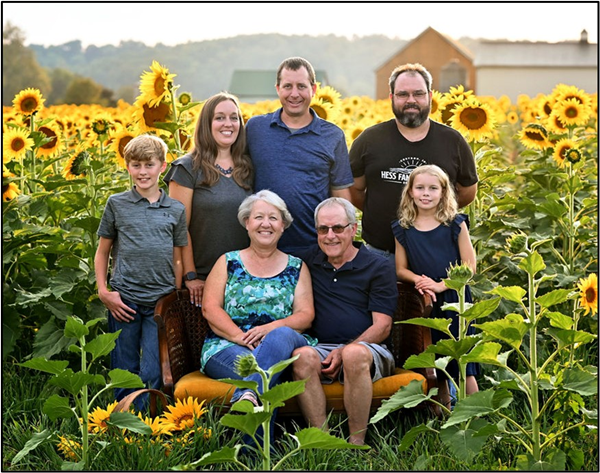 The Hess family includes grandparents Sandy and Chuck (in front), Logan, Valerey, Eric, Eric’s brother Clayton and Sydney.
At Hess Family Farms near Corydon, Ind., sunflower has become the centerpiece of a community project rooted in soil health, education and local giving.
The Hess family farms about 700 acres in southern Indiana. They grow white corn, popcorn, soybeans and barley seed and also raise a small number of freezer beef cattle. Farming runs deep in the family; they have been working the land since 1854. Eric manages the operation with help from his wife, Valerey, their children Logan and Sydney, his parents Chuck and Sandy, and a small seasonal crew. He also works full-time as a loan officer with Farm Credit.
Eric first planted sunflower to improve his soil, wanting to strengthen soil structure and increase diversity in cover crop mixes. He added sunflower alongside turnips, radishes, crimson clover, hairy vetch, barley and rye. The sunflower thrived and the neighbors loved them. That prompted him to experiment with a full stand. In 2024, Hess planted 20 acres of Dyna-Gro Game Plan sunflower, timing the bloom to coincide with the local Lanesville Heritage Festival.
“We wanted to use the sunflower as a cover crop after harvesting barley, recoup our costs and help the community at the same time,” Eric explains.
The family opened the field as a simple pick-your-own patch with a few signs, cutting tools and a donation box. Community support quickly surpassed expectations and they contributed $700 to the Lanesville School “Embracing Lanesville Families” (ELF) program, which provides food, holiday gifts and seasonal support for local students. Both Logan and Sydney attend Lanesville schools, which made the effort personal.
“You have to be a student or a family with students at school to benefit from the ELF program, and there's an application process to go through to be selected for it,” Valerey says. “We like it because it all stays right here and helps families that we know. Even though the program is very anonymous and we don’t know exactly who we’re helping, we know we’re helping people that we may talk with on a regular basis. They may be having a hard time, and we don’t even know it.”
The Hess family expanded the project in 2025. They welcomed photographers for a fee, added a walking path through the field, and created several photo prop areas. Guests traveled from as far away as two hours to see the field at peak bloom. This year they were able to donate $1,100 to the same program.
After the blooms faded, Eric turned his attention back to the practical side of the crop. During the first season, he hesitated to harvest, unsure whether enough viable seed remained. Winter delays made the window seem even narrower, and he assumed the opportunity had passed. But when he checked the field in early spring, he was surprised to find the heads in good condition; he harvested them successfully in late March using a draper header. Seed loss was higher than ideal, but the unexpected harvest created a new opportunity for Logan and Sydney. They bagged the seeds into 30-pound sacks and sold them locally as birdseed. Some of the seed also went to a nearby mill for use in wildlife feed.
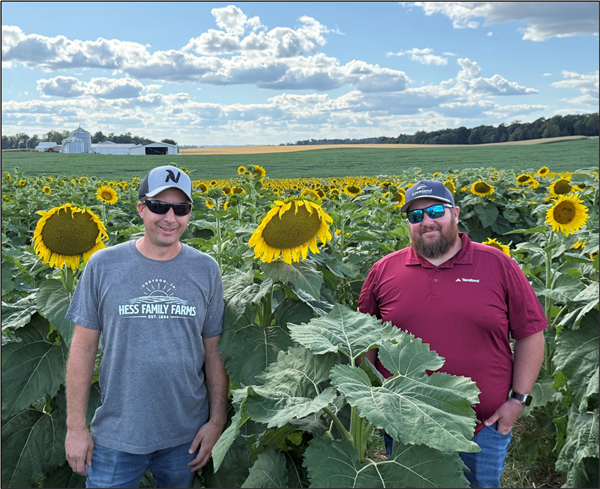 Eric Hess (left) with Matt Baker, crop consultant for Nutrien Ag Solutions
Eric says soil observations have been promising. Corn planted after mixes that included sunflower showed improved quality. Sunflower’s deep roots and the diversity they provided appear to contribute positively to long-term soil goals. The family continues working with their agronomist to document changes in soil structure and nutrient cycling.
The Hess family also continues refining both the growing and agritourism aspects of their sunflower project, blending practical farming with charitable impact in a way that reflects their values and the deep agricultural heritage of their farm.
Visit the Hess Family Farms page on Facebook (https://www.facebook.com/profile.php?id=61564653407332) for updates on the project and bloom information. — Jody Kerzman