Preliminary Results from 191 Fields Show That Disease Again Was the Most-Limiting Yield Factor
 The National Sunflower Survey is a long-running, multi-state effort coordinated by North Dakota State University Extension to document agronomic constraints affecting sunflower production. By leveraging a standardized Qualtrics-based survey and a broad county agent network, the project provides consistent, field-level insights into production challenges across years and regions. The 2025 crop survey results presented in this report, it should be noted, are preliminary.
Team & Collaboration
The survey is supported by numerous county agents and specialists. The lead team is composed of Febina Mathew (NDSU), Victor Gomes (NDSU), Patrick Wagner (SDSU), Jarrad Prasifka (USDA), Janet Knodel (NDSU), Anitha Chirumamilla (NDSU), Leo Bortolon (NDSU), and Jeff Stachler (NDSU), and coordinated by Ana Carcedo (NDSU).
Our collaborators across states include: Nicolas Cafaro La Menza, Calvin L. Trostle, Jeanne Falk Jones, Morgan Cott, Bob Harveson, Ron Meyer and William Underwood. A total of 44 North Dakota county agents were trained. Special thanks are extended to Joe Ikley, Janet Knodel, Anitha Chirumamilla, Jeff Stachler, Sam Markell and Denis Colombo for their participation on the trainings.
Survey Scope & Participation
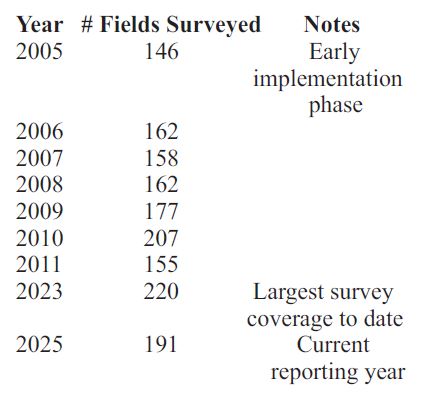
The sunflower survey has expanded substantially over time, from 146 fields in 2005 to 220 fields in 2023. In 2025, a total of 191 fields were surveyed across six U.S. states (North Dakota South Dakota, Nebraska, Kansas and Colorado) and one Canadian province (Manitoba).
 General Description
Sunflower production systems represented in the survey were predominantly oilseed types, which accounted for 93% of surveyed fields, while confection sunflower represented 7% of the total.
The most common previous crop was corn (53%), followed by small grains (37%), whereas a smaller proportion of fields followed broadleaf crops (4%) or had an unknown previous crop (6%).
In terms of tillage practices, conventional tillage was the most frequently reported system (54% of fields), while no-till and minimum tillage were each used in 24% of fields. Sunflower production was overwhelmingly conducted under dryland conditions, representing 98% of surveyed fields, with only 2% of fields reported as irrigated.
Primary Limiting Factors (Rank #1)
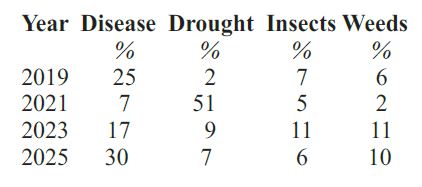
Across survey years, disease consistently emerged as a dominant primary limiting factor — particularly in 2019, 2023 and 2025. Disease and drought have regularly ranked among the most important constraints, though their relative importance varied by year, highlighting the influence of environmental conditions on sunflower performance.
The results presented in this report correspond to the surveys submitted up to December 1st (n=185).
Secondary Limiting Factors (Rank #2)
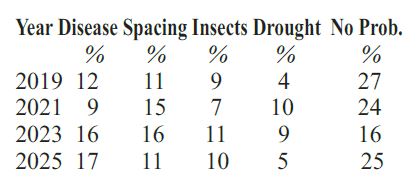
Secondary sunflower yield limiting factors frequently mirrored primary constraints, suggesting compounding effects of biotic and abiotic stresses. A notable proportion of fields reported diseases, if not primary, as a secondary limiting factor, highlighting the relevance of this factor.
Weeds
Weed pressure in surveyed sunflower fields was dominated by a small number of species, with kochia being the most frequently reported weed, occurring in 22.2% of observations. Green foxtail was the second most common species (11.2%), followed by redroot pigweed (7.03%) and then yellow foxtail (6.13%).
Several perennial and volunteer species were also prevalent, including volunteer small grains (5.77%), Canada thistle (5.23%), field bindweed (4.32%), and volunteer corn (4.32%), reflecting rotational and management carryover effects.
Broadleaf weeds of concern included common ragweed (3.24%), Palmer amaranth (3.06%), cocklebur (2.7%) and lambsquarters (2.34%), while grass species such as barnyardgrass (2.34%), foxtail barley (1.8%), and wild oat (0.54%), were reported at lower frequencies.
Although less common, the presence of waterhemp (2.16%), Palmer amaranth, and Powell amaranth (0.18%) is noteworthy due to their resistance potential and implications for long-term weed management.
Collectively, these results highlight the continued importance of integrated weed management strategies in sunflower production systems, particularly for managing kochia, foxtail species and emerging herbicide-resistant broadleaf weeds.
Insect & Bird Damage
Insect and bird damage assessments indicated that bird damage was the most frequently observed issue, with 34% of surveyed fields reporting damage. Insect pressure was less prevalent but still notable. Damage accounted for 11% of observations, with additional insect damage categories each representing 8% of fields.
Damage attributed specifically to the long-horned beetle was reported in 14% of fields, highlighting its importance as a stalk-related pest in sunflower production systems.
Overall, these results suggest that while insect pressure was generally moderate, bird damage remains a primary constraint, emphasizing the need for integrated pest management strategies that address both insect pests and vertebrate damage.
Seed Sample Analysis
An additional 143 samples were collected, covering North Dakota, Kansas, and Minnesota, ensuring broad geographic representation. In North Dakota, overall damage levels were generally low, averaging 4% across surveyed fields. However, a small subset of samples (n = 6) exhibited substantially higher weevil damage, with an average of 21.5%, and several additional samples showed moderate but concerning damage levels (~10%).
Seedset issues were also observed in confection sunflower fields, a pattern that is consistent with historical observations and is considered typical for this market class under regional production conditions.
Diseases
Disease incidence in surveyed sunflower fields was dominated by Phoma, which was reported in 18% of observations, making it the most frequently identified disease. Phomopsis was the second most common disease, occurring in 7.7% of fields.
Diseases associated with Sclerotinia were also present, with head rot reported in 6.2%, wilt in 1.5%, and mid-stalk infection in 1.1% of observations, indicating multiple disease expression pathways within this pathogen complex.
Other diseases occurred at relatively low frequencies, including Rhizopus (1.8%), Verticillium (0.4%), charcoal rot (0.2%) and downy mildew (0.2%).
Overall, these results suggest that while most diseases were present at low incidence, Phoma and Phomopsis remain the primary disease concerns in sunflower production systems, with Sclerotinia continuing to pose a notable risk.
Phomopsis Stalk Rot Assessment
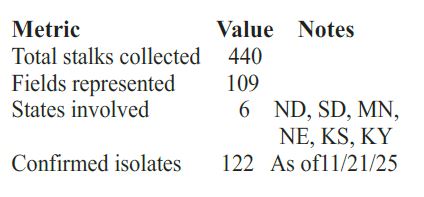
To complement survey-based observations, a targeted Phomopsis stalk rot assessment was conducted. A total of 440 stalks were collected from 109 fields across six U.S. states (ND, SD, MN, NE, KS, KY). All samples were plated by November 21, 2025, resulting in 122 confirmed Phomopsis isolates to date.
Discussion & Implications
Results from the 2025 National Sunflower Crop Survey underscore the persistent importance of disease management in sunflower systems, while also highlighting strong interannual variability driven by weather-related stressors such as drought. The consistency of plant spacing and insect pressure across years suggests ongoing opportunities for targeted extension programming focused on stand establishment and integrated pest management.
The integration of survey data with pathogen isolation efforts strengthens the biological relevance of reported disease concerns and provides a foundation for future research on pathogen prevalence, distribution, and management strategies.
More Information
A full report on the 2025 National Sunflower Crop Survey will be presented at the January Sunflower Research Forum. Questions may also be addressed to:
Dr. Ana Carcedo
Broadleaf Crop Agronomist
NDSU Extension
Email: a.carcedo@ndsu.edu
Phone: 701-831-5796